Why Indonesia's Teak Furniture Industry Needs to Rethink How It Cuts Wood
Indonesia is the world's teak capital.
Jepara alone has more than 5,000 furniture businesses and 75,000 workers, contributing roughly 10% of Indonesia's total exports. Indonesian furniture manufacturers are
targeting $5 billion in annual furniture and handicraft exports — and teak outdoor furniture is at the heart of that ambition.
The craftsmanship is world-class. The material is irreplaceable. The export demand from Europe and North America has never been stronger.
But there's a bottleneck that hasn't changed in decades — and it sits right at the beginning of the production line.
The problem nobody talks about: the first cut
Before a teak chair leg, table slat, or armrest takes shape, someone has to stand in front of a raw teak board and figure out how to use it.
The traditional workflow looks like this:
A skilled worker studies the board, finds the grain, identifies the knots and cracks, and marks out product shapes by hand with chalk or pencil.
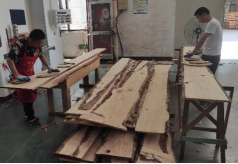
The marked board is roughly cut into sections — by hand, by eye.
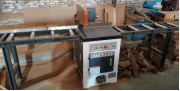
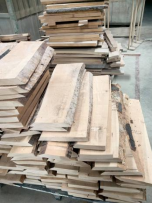
Each section is guided through a band saw to produce the rough blank.
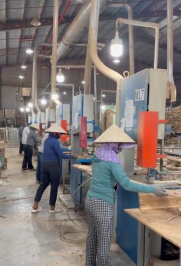
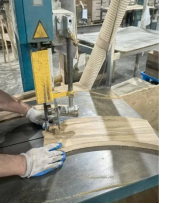
Three steps. Three workers. And at the end of it, a rough blank with tolerances
that depend entirely on how steady the worker's hand was that day.
Even as Jepara artisans increasingly embrace CNC routers to translate designs into repeatable code, the raw material preparation step — where teak is still
marked and cut by hand —remains the least optimized part of the entire production chain.
The result: inconsistent blanks, high material waste, and a production floor that can only move as fast as its most experienced worker.
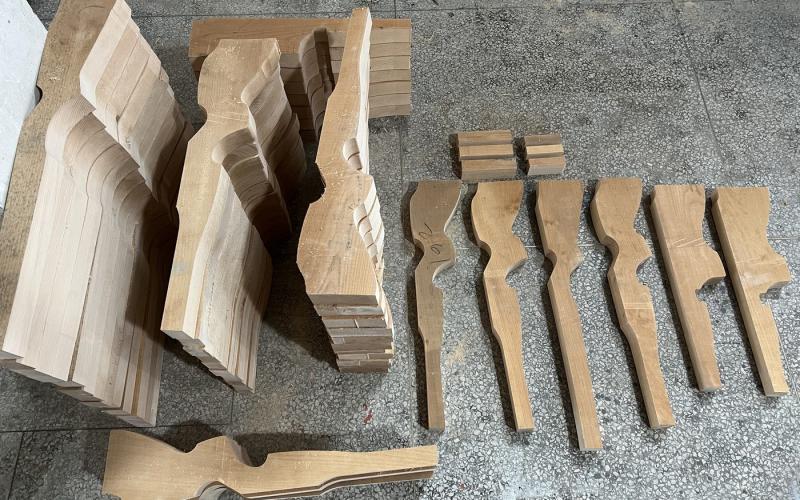
What we just delivered to one of Indonesia's leading outdoor furniture factories
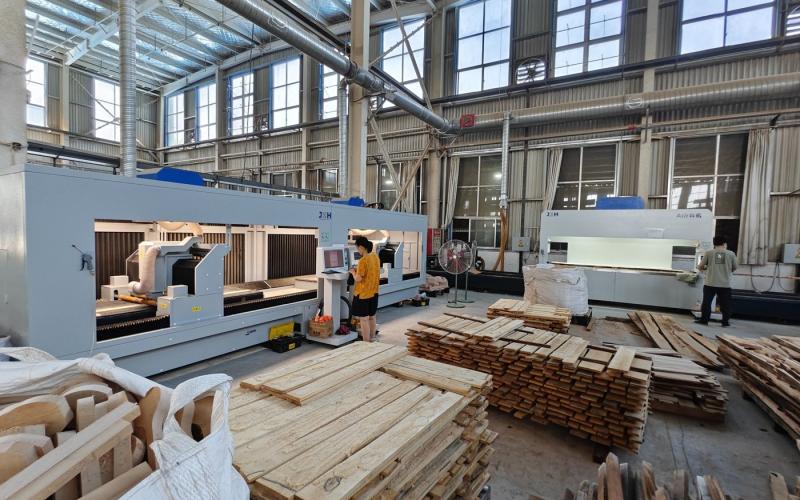
We've just completed the installation of a JXH Dual-Station AI Cutting Machine — our One-Drives-Two system — at one of Indonesia's top-tier teak
outdoor furniture manufacturers.
Here's what changed for their cutting floor:
•Any placement, automatic detection — Teak boards are placed on the worktable in any position or orientation. The system's cameras automatically identify
left and right workstations — no manual alignment needed.
•Full surface AI scan — The machine scans the entire board surface, mapping the exact contour and automatically detecting every defect — knots, cracks, wormholes, sapwood — in seconds.
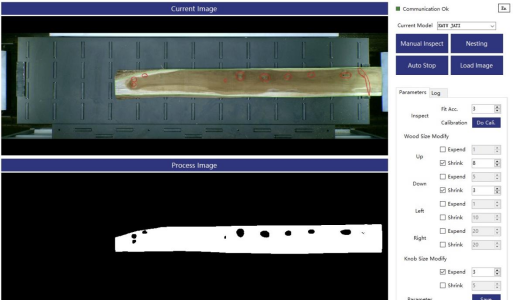
•Intelligent nesting, maximum yield — The AI generates the optimal cutting layout across the full product list, maximizing the number of usable blanks from
every board. No human estimation. No wasted teak.
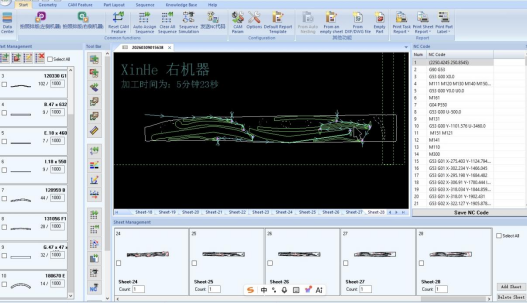
•Automatic path optimization and cutting — Tool paths are calculated and executed automatically. One operator monitors both stations. The machine does the rest.
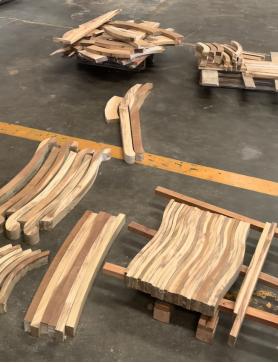
What used to take three workers across three manual steps now runs with one operator, at higher precision, with significantly less waste — on every board, every shift.
Results at a glance
Material Utilization: +8–10%
Cutting Precision: <1mm
Labor Saved: 3–4 workers
Production Capacity: +40%
Why this matters now
Wood accounts for 64% of Indonesia's furniture market, underpinned by the country's teak, mahogany, rattan, and bamboo resources. Indonesia's furniture market is
projected to grow at 6.39% CAGR through 2032.That growth creates opportunity — but it also creates pressure. Export customers in Europe and North America expect tighter tolerances,
faster lead times, and consistent quality across every container. Meeting that standard with a manual cutting floor is increasingly difficult.
The factories that will lead Indonesia's next phase of furniture export growth won't just be the ones with the best craftsmen. They'll be the ones that combine Jepara's
irreplaceable woodworking heritage with production processes that can scale. Intelligent wood preparation is where that transformation starts.
If you're a teak or mahogany outdoor furniture manufacturer in Indonesia — or a machinery distributor serving this market — I'd love to connect.