



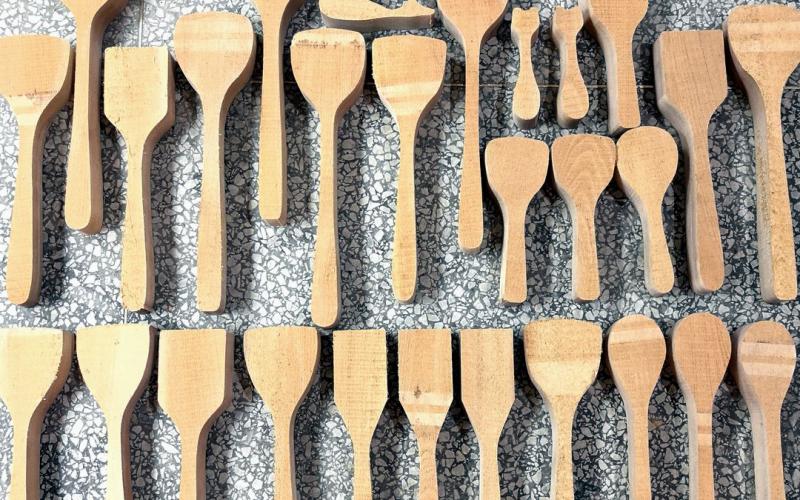
Wooden kitchenware parts often have curved shapes, narrow handles, and different size requirements. When these parts are marked by hand, material usage depends heavily on operator experience, and valuable solid wood can be wasted.
Why kitchenware parts create nesting challenges
Spatulas, handles, scoops, and similar components are not simple rectangles. Their curves and narrow sections require careful placement, especially when the raw board has knots, cracks, bark edges, or color variation.
Use board scanning before cutting
Scanning helps the system understand the real board boundary and visible defect areas. This gives the nesting software better information than manual measurement alone.
Let automatic nesting improve material use
Automatic nesting can place different part sizes inside the same irregular board area, helping factories use more of each board while keeping important parts away from visible defects.
Reduce manual marking and rework
When operators no longer need to draw every part by hand, production becomes more consistent. The workflow can move from board scanning to layout generation and CNC cutting with fewer manual steps.
Best-fit equipment
For wooden kitchenware factories, JXH AI cutting machines are suitable for processing irregular solid wood boards into shaped parts with better consistency and less waste.